Language

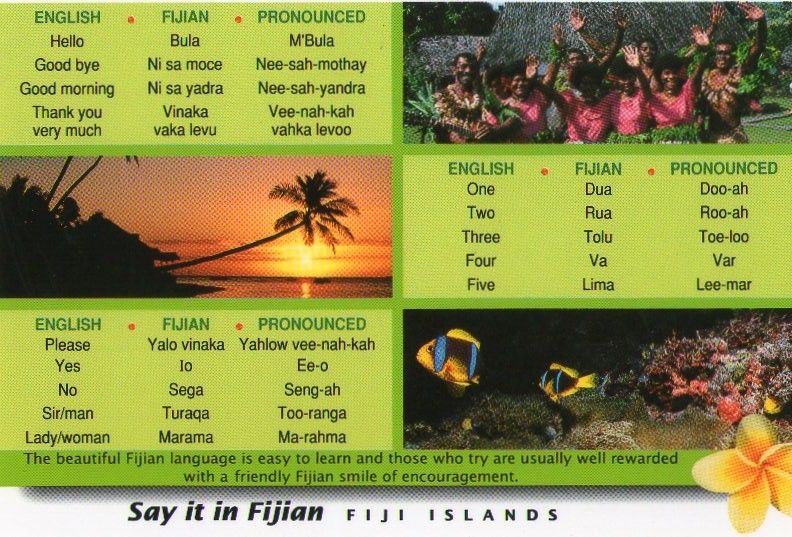
A showcase of the Native Fijian Language
Image credit: Google

After Papua New Guinea (PNG), Fiji is the second biggest island country in the South-west Pacific and the center of the area. About all Fiji Islanders have either Fijian or Fiji Hindi as their first language, in generally equivalent numbers, while the previous frontier language, English, with not many local speakers, has held a significant job, especially as mode of guidance and most widely used language. In spite of the fact that the Constitution ostensibly gives these three dialects equivalent status, the vernaculars, including some minority dialects, remain the principle media of correspondence, while English commands in most authority circles. Disregarding continuous declarations about the significance of vernaculars, small arranging happens, and there is little acknowledgment of non-standard lingos. The Fijian language, albeit spoken by a couple of 400,000 local speakers, is a noteworthy part of Fijian culture. As of late, thinks about have been led so as to pinpoint how and why this piece of Fiji might be in danger for eradication and endangerment.  

Instead of grasping the assorted phonetic collections and capability levels, inside the network, momentum instructive arrangement and past research on Fiji’s dialects has would in general think about the numerous dialects utilized in Fiji to outer benchmarks. English correlations specifically talk about high (acrolectal) versus low (basilectal) benchmarks of English creation inside the Fiji people group and contrast and global assortments of English where English is the overwhelming language.

Since Education significantly impacts the procurement of language, this paper puts huge accentuation on issues concerning essential and secondary training in Suva, and the issues confronting the Fijian educational modules today. Proposals and solutions for issues concerning training are given, alongside sorted out undertakings and approaches set up which concern advancing the Fijian language. Theories are likewise provided concerning the standpoint for the language, and whether it is sure or negative.

The Fijian language depicts the numerous manners by which language characterizes a culture. So as to completely get a handle on how the Fijian language has landed at the point it is at today, a short look at its history is vital. History of a language helps in characterizing its personality, showing the weight it pulls in a general public.

For quite a long time the Fijian government has been talking about the likelihood of expanding the utilization of Fijian in the scholarly field. However, Parliament in Fiji is likewise helped to remember the significance of keeping English a used language. As indicated by Milner et al, nearly all correspondence between government officers is in English [The official language of Parliament was authoritatively English as of 1970]; English is additionally the language of the law courts (62). Mangubhai and Mugler guaranteed that the Fiji Education Commission of 1969 pushed for progressively vernacular instruction, however that nothing was actually done about it . Discussions concerning the utilization of English/Fijian in schools have proceeded right up ’til today, resulting so far with the present situation. Today, vernacular dialects are exclusively utilized in the primary year of essential instruction, and they start to blur out as the years go on and understudies become progressively skillful in the English language. When understudies are skillful in English, vernacular languages are then educated as subjects. At present, the use of Fijian in schools is eventually the choice of each free establishment. According Marist Primary, they have however to execute Fijian at all. At the point when asked about the thinking be rear this, educators clarified that instructing English is simpler on educators because of persuasion contrasts among educators and understudies, just as the facilitate that accompanies having the option to educate about a culture outside of Fiji. The absence of qualified instructors was too an issue at Marist. Additionally, not exclusively are governments in charge of guaranteeing that Fijian is actualized into educational module, they are additionally the subsidizing hotspot for schools.

To close off thus, such actions taken together by the Fijian Government and the people will apprehend and surely improve the local native languages that our ancestors has blessed us with.
Culture and Arts

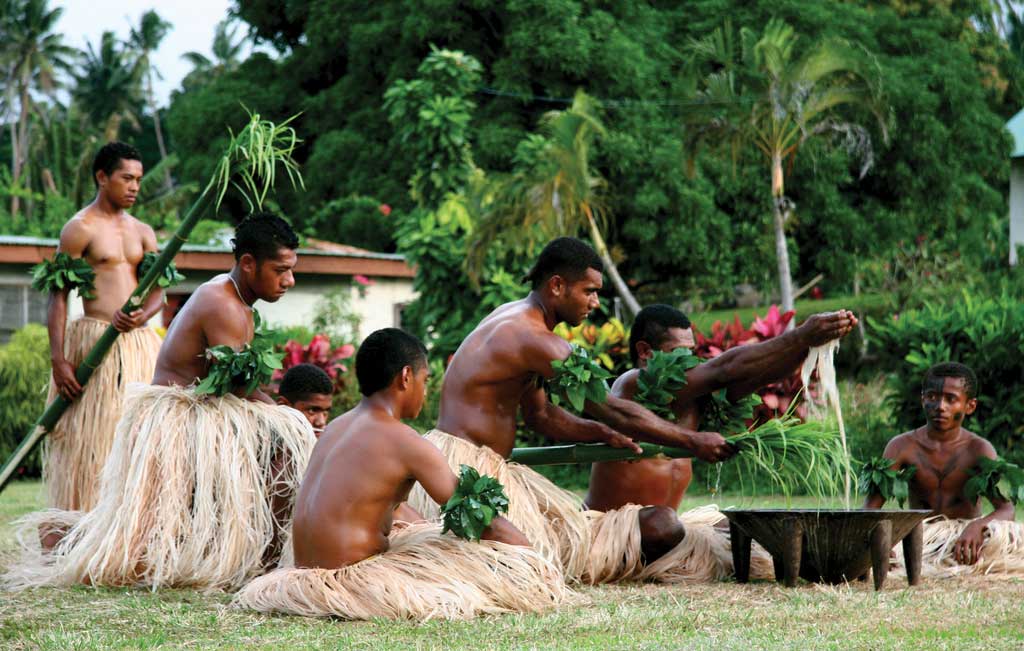
A depiction of Fijian warriors during the Kava Ceremony
Image credit: Google

Quite a bit of Fiji’s specialties and artworks is an impression of the nation’s Polynesian and Melanesian legacy. Customarily, ladies’ artworks and men’s specialties are discrete, the ladies prevalently responsible for ceramics (pottery) and the men of woodcarving. Sadly this unique range of Fijian talent and many more are diminishing as western lifestyle seems to be more and more indulging in the lives of everyday Fijians. Though at risk, the Fijian government together with numerous are trying their best to revive the culture and artistic virtue of the local people.

Craftswomen from Fiji are also known for making tapa, or masi, which is formed out of the bark of mulberry trees and after that beautified with dark and rust-hued structures, intermittently with stencils speaking to a specific town or family. Masi was customarily utilized as an undergarment and generally connected with social ceremonies, yet is presently regularly given as a blessing on formal events and utilized as inside decorations. The island of Vatulele, found south of Viti Levu, is famous for its masi work.

Female craftsman additionally make mats and bins by weaving together leaves of the pandanus tree (and now and again the coconut palm). The procedure includes numerous means, including gathering, de-thorning, bubbling, drying and blanching the leaves and after that enhancing the woven mats with outskirts of shaded fleece. The mats come in various sizes and are frequently given as wedding blessings and are a prevalent vacationer thing in Fiji. Craftswomen additionally make taa, a sensitive and hard to create material produced using the youthful, unripe leaves of palm trees, which is utilized to form caps and satchels.

Male craftsman in Fiji, in the interim, are most acclaimed for their dazzling woodcarving work. Generally, the woodcarving procedures and plans were utilized for molding things, for example, barbarian forks, yaquona vessels and lances and clubs utilized in fighting. A portion of these woodcarvings can be found in plain view at The Fiji Exhibition hall in Suva while others can at present be purchased from neighborhood craftsman. The Tanoa drinking bowl, utilized for serving kava, Fiji’s national beverage, is the most well-known wood carved thing accessible for procurement.

The advancement of arts and culture and the safeguarding of customary artworks are a significant piece of Fiji’s improvement methodology. The Bureau of Culture and Legacy arranges expressions occasions and endeavors to keep up and grow a business opportunity for customary crafted works from Fiji. It additionally sorts out the Melanesian Expressions and Social Celebration, which is held at regular intervals. For some, little islands creating states the center has been to keep up and remain in front of the improvement weights and difficulties which have been applied on them for a long time or even hundreds of years especially from universal, outer and national requests and impact. At same time less accentuation has been put on the feasible utilization of the bounty of the normally happening assets of the land and ocean just as the acknowledgment of the customary learning holders of expressions of the human experience and sciences which are regularly disliked and marked as having a place with the past and not proper in ‘The present world’.

The long haul benefits for little island creating states protecting, upgrade and advance little islands substantial and immaterial social legacy won’t just help with structure national pride however will likewise address issues on personality by advancing shared comprehension between people in various local gatherings towards a serene conjunction and will guarantee the duration of customary information and practices for self-supportable networks dependent on normally happening assets and expertise for who and what is to come.

Climate Change and Fiji

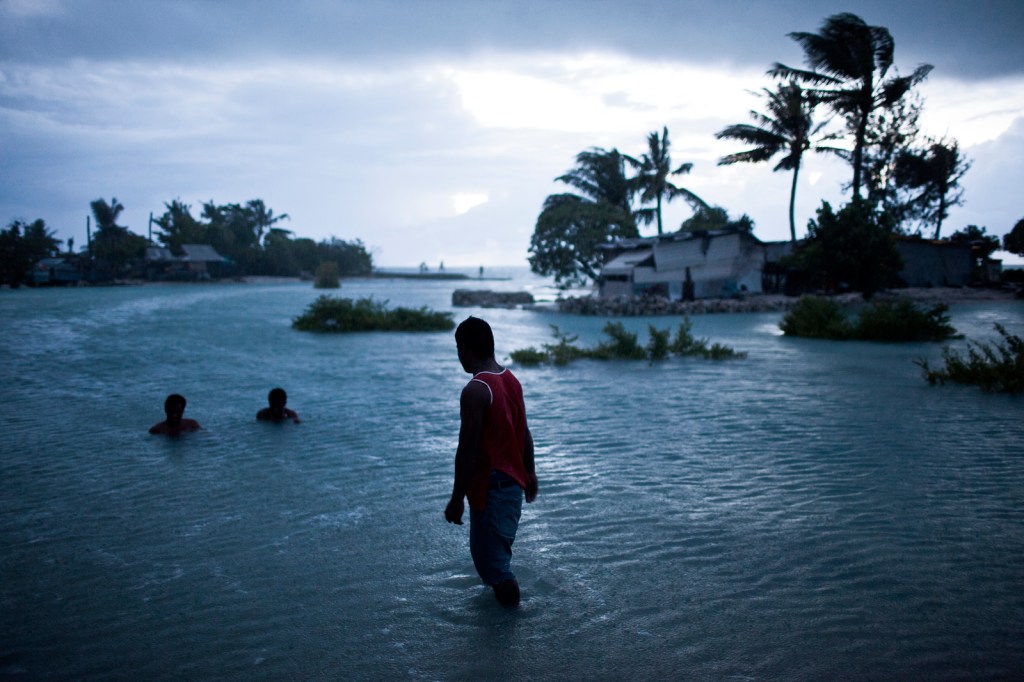
Sea level rise is the most visible proof of Climate change
Image credit: Google

“Unless the world acts decisively to begin addressing the greatest challenge of our age, then the Pacific, as we know it, is doomed,” this was the statement given by the Fijian Prime Minister Mr Frank Bainimarama at the 23rd Climate Change Conference (COP23). Climate change as we know it is real and is affecting our beloved nation like never before. Fiji hardly contributes in the global carbon emission release and yet gets harshly affected by its effects. The country however is taking a sustainable turn in fighting this global crisis of Climate change.

As indicated by Fiji’s National Environmental Change Strategy, worldwide ocean level changes will dramatically increase before the century is over. Since 1993, Fiji has recorded a 6 millimeter (0.2 inch) increment in its ocean level every year, bigger than the worldwide normal. The quick ascent in ocean levels and the subsequent saltwater interruption that originates from the expanded savagery of seaside floods have made parts of the island country appalling. Fiji’s future depends on countering the impact of climate change.

In 2012, occupants of Vunidogoloa, a town on the shoreline of Fiji’s second-biggest island, Vanua Levu, turned into the country’s first network to move because of environmental change. The town’s 26 homes sat negligible meters from the coast, however with four many years of a higher tide and heavier precipitation, Vunidogoloa—its homes, gardens, harvests and trees—ended up helpless before determinedly infringing seawater. Relocating to higher ground offered the main outstanding choice for the network.

Without a doubt, arranged movement in Fiji is a generally new reaction with the impacts of environmental change, and it is just seen if all else fails. Movement is an intricate procedure and can be horrible for those included. It isn’t only an instance of financial matters and physical structures, there are various complex, non-unmistakable perspectives related with movement, which can incorporate difficulties to character, just as different mental, social, enthusiastic and social harms.

Three towns have just been completely moved, two in part moved and two more in the underlying phases of migration. What’s more, as indicated by the Fijian Green Development Structure, there are around 40 additional networks prescribed for movement.

Fiji has a Green Development Plan and has forcefully sought after and actualized approaches to advance reasonable improvement in the nation, all while joining forces with the private division and worldwide associations to hoist the issue on the worldwide stage.

Fiji has vowed to change totally to sustainable power sources by 2030 and has embraced a reforestation approach expected to store carbon from crisply planted trees. Working close by the Worldwide Condition Office, the Green Atmosphere Reserve and a few Joined Countries offices, Fiji has initiated endeavors to screen and dispatch quick reaction to atmosphere related dangers.

In the universal field, Fiji has facilitated abnormal state appointments from UN bodies to address the effect of environmental change. Fiji was the primary country to confirm the Paris Understanding, which looks to confine temperature ascend to “well underneath” 2° Celsius. Fiji is one of 43 countries on the Atmosphere Helpless Discussion and has been vocal advocates of restricting temperature ascend from an unnatural weather change to 1.5° Celsius. In 2017, Fiji turned into the principal little island creating state to join the Under2 Alliance, which is a universal agreement among urban areas, states and nations focused on restricting the expansion in worldwide normal temperature to underneath 2 degrees Celsius by either lessening their ozone harming substance outflows from 80 percent to 95 percent beneath 1990 dimensions or holding discharges to under 2 yearly metric tons for every capita by 2050.

Such precautionary measures taken by the Fijian government together by the help of the United Nations gives us individuals of this beloved nation an assurance that we could combat the crisis of Global warming.

Natural habitat and Biodiversity

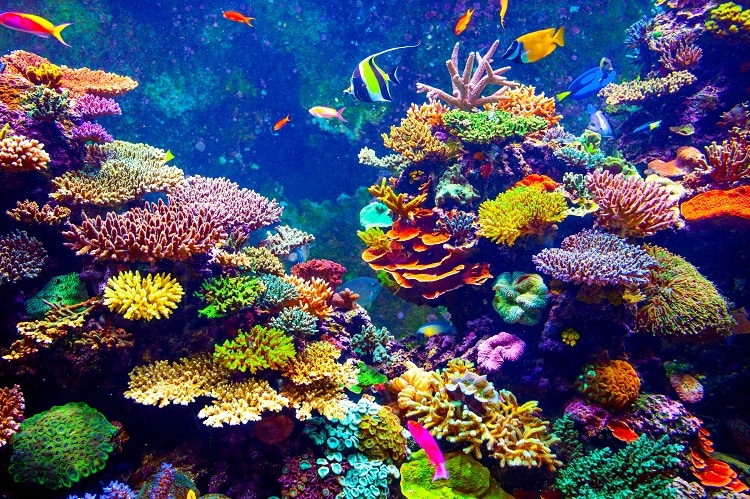
An array of Biodiversity in Fiji’s reefs
Image credit: Google

Fiji has always been undergoing a phase of transitional damage upon its natural to cultural wonders. This first of the series of upcoming articles will thus focus on some very important issues that Fiji is currently dealing with and how the nation is fighting back. Fiji has always had a fame for beautiful natural surroundings and surreal biodiversity, many of which is very much endemic to only this region of the universe.

The first theme of interest in this blog would be on Natural habitats and Biodiversity. The uniqueness of Fiji’s wildlife is sometimes what gets these nation’s gems into grave danger. Fiji has lost many of its natural wonders mainly because of economic pressures that enable extraction of resources from certain sea and land mass. The over exploitation of land for agricultural purposes has also been a major reason of natural habitat loss which later triggers in the vanishing of numerous wildlife species. Improper handling of the tourism industry also plays a dangerous role in the disappearance of many endemic heritages and biodiversity in the nation. Damaging of the coastal environment such as coral reefs, beaches and estuaries through massive tourism exposure really threatens the future of numerous wildlife and habitats of the same. However just like an enduring warrior, Fiji too rebukes of its losses.


the Fijian government thus have together with the UNESCO World Heritage has a total of 9 protected areas all over the Fijian nation which is of national, cultural and natural heritage. Majority of these falls under the conservation of natural habitat and biodiversity respectively. The nation is also taking other preserve worthy actions towards the conservation phenomena. The Fijian government has started charging a levy of twenty cents per any plastic bag bought from the supermarkets. There has been a control on fishing in the breeding season of some endemic species and catching of turtles is strictly illegal and if found guilty of these will incur huge fines and harsh consequences.

Numerous campaigns are organized by NGO’s together with the Fijian government that now educate individuals on the importance of roles played by our natural habitats and the many biodiversity that calls it home. This has had an importantly positive effect on the natural system as more and more people are now finally getting to know nature’s worth and are working towards conserving it. That’s all for the first blog but be sure to get back as we’ll next be witnessing an important take on Fiji and the issue of “CLIMATE CHANGE”!